Guide to Forklift Tire Retreading: When and Why It Matters
Forklift tire retreading is a cost-saving option for businesses in Pakistan's logistics and warehousing sectors. It involves adding new tread to used tire casings, reducing costs by 30%–50% compared to new tires. Retreading extends tire life, ensures safety, and supports eco-friendly practices by reusing materials.
Key Highlights:
- When to Retread: Look for reduced tread depth, visible damage, or signs of wear like cracks or balding. Overloading or long usage hours also accelerate wear.
- Process: Tires undergo inspection, buffing, tread application, and curing, followed by rigorous testing for safety and performance.
- Benefits: Lower costs, restored traction, and reduced waste. Retreading uses less oil and prevents millions of tires from ending up in landfills.
- Costs in PKR: A new forklift tire costs Rs 45,000–Rs 1,50,000, while retreading reduces this to Rs 13,500–Rs 75,000.
Retreading is an effective way to reduce expenses and maintain operational efficiency for forklift fleets. Regular inspections and timely retreading can maximize tire performance and lifespan.
When to Retread Forklift Tires: Key Indicators
Knowing the right time to retread forklift tires can prevent unexpected downtime and protect your investment. Here are some critical signs to help you determine when it's time to act.
Tread Depth and Wear Patterns
For cushion tires, the 2-inch rule is a widely accepted guideline: if the tire's diameter has decreased by two inches from its original size, it's time to consider retreading or replacing it. Many manufacturers make this process easier by including a "wear line" or "60-J line" on the tire's sidewall. This line typically represents about 20% of the original tire thickness, and once the rubber wears down to this mark, immediate attention is needed.
If there’s no wear line, you can use the manufacturer's name or size markings as reference points. For solid pneumatic tires, a specific ring or band often acts as an indicator. When the tread reaches this marker, it’s a clear sign that the tire is worn out. Additionally, look for balding - smooth areas in the centre or worn lugs along the edges of pneumatic tires. Ignoring these signs can increase stress on forklift components by 15% to 18%. Spotting these indicators early ensures timely retreading.
Visible Damage and Surface Cracks
Visible damage, like surface cracks or chunks of rubber missing, can compromise both safety and performance. Chunking - where large pieces of rubber break off - or tears caused by debris can destabilise the forklift. As noted by the Forklift Tire Company:
Contact with sharp edges can slice off large portions of a tire, often leading to imbalance. This is one of the most dangerous of tire problems.
Radial cracks, appearing as fine lines on the sidewall, are another red flag. These often result from heat buildup due to overloading or extended runs without a load. Flat spots - irregular, flattened areas on the tire - can form from sudden braking, misalignment, or leaving a loaded forklift stationary for too long. For cushion tires, the screwdriver test is a quick way to check safety: inserting a screwdriver into the gap between the rubber and the internal metal band can reveal if the tire is no longer secure and needs immediate replacement.
Usage Hours and Load History
The way a forklift is used plays a major role in determining when retreading is necessary. Unlike vehicles with suspension systems, forklifts rely entirely on their tires to absorb the machine's weight. Drive tires often carry over 9,600 lbs (around 4,350 kg), while steer tires bear approximately 1,300 lbs (about 590 kg). Overloading accelerates wear, leading to issues like chipping, base separation, and radial cracking, which can damage the tire casing.
In high-use environments - where forklifts operate for long hours, at high speeds, or across multiple shifts - heat buildup becomes a significant problem, wearing down the tire casing faster. Monitoring how often forklifts are used at maximum capacity is critical, as heavy loads can speed up deterioration. For businesses running multiple shifts, retreading should be scheduled earlier to avoid excessive wear caused by constant friction and insufficient cooldown periods. John Wofford from Lilly Forklifts explains:
If you leave loads standing on forklifts overnight or longer, solid tires can form 'flat spots.'... If bad enough, flat areas will cause a very bumpy ride for the operator and the load, which can lead to unnecessary product damage.
The Forklift Tire Retreading Process
Retreading is a cost-effective way to restore tire performance while maintaining safety and quality. The process involves several detailed steps, including inspection, preparation, application of new tread, and rigorous testing to ensure the retreaded tire meets safety standards.
Inspection and Surface Preparation
The first step in retreading is a thorough inspection of the tire casing. Technicians carefully check for any damage, such as holes, cracks, bead issues, or exposed cords and wires. The casing's condition determines whether it can be retreaded. Modern facilities often rely on Non-Destructive Testing (NDT) to evaluate the internal structure of the tire, identifying hidden issues like rusted or damaged steel cords that may not be visible externally. As explained by the Tire Retread & Repair Information Bureau:
"Thanks to various non-destructive testing machinery now in place at most retread plants, retreaders now have the ability to actually see inside the tire to determine if any steel cords are damaged or rusted."
If the casing passes inspection, the worn tread is removed through a process called buffing, which ensures a smooth, clean surface for applying new rubber. Any structural damage to the casing, including damaged steel cables, is repaired at this stage to maintain the tire's integrity. For optimal results, tires should be sent for retreading when the tread depth reaches 6/32nds of an inch (around 4.8 mm). This prevents further casing damage and maximises the casing's reusability.
Once prepared, the casing is ready for the application of new tread material.
New Tread Application and Curing
There are two main methods for applying new tread material:
- Pre Cure System: A pre-vulcanised tread is bonded to the casing.
- Mold Cure Method: Raw rubber is applied and shaped in a heated mould.
Both methods produce high-quality retreaded tires, with the choice depending on the facility's equipment and production needs.
After the new tread is applied, the tire undergoes the curing process, where heat and pressure are used to bond the new tread securely to the casing. This step ensures the retreaded tire achieves durability and performance comparable to a brand-new tire.
Final Quality Control and Testing
Every retreaded tire undergoes strict quality checks to ensure it meets the same safety and performance standards as a new tire. A DOT stamp is added to the sidewall, providing details about the retread plant and manufacture date for traceability. Inspectors then perform visual checks to identify any surface issues, such as creases, seams, or excess rubber that could signal bonding problems. After mounting, technicians conduct a spin test to confirm the wheel is balanced and aligned properly for a smooth ride.
| Quality Control Measure | Purpose |
|---|---|
| Non-Destructive Testing (NDT) | Detects internal flaws or rusted steel cords |
| DOT Stamping | Tracks the retread plant and manufacture date |
| Visual Inspection | Identifies surface defects such as creases or "chunking" |
| Balance & Spin Test | Ensures the tire spins smoothly without wobbling |
These quality control measures ensure retreaded tires are safe and reliable, while also preserving about 90% of the material from used tires. This makes retreading an efficient and sustainable solution for extending tire life.
Benefits of Forklift Tire Retreading
Retreading offers a smart solution for businesses in Pakistan managing forklift fleets, delivering cost efficiency, safety improvements, and reduced environmental impact.
Cost Savings for Pakistani Businesses
One of the biggest advantages of retreading is the financial relief it provides. Instead of purchasing entirely new tires, businesses can reuse the most expensive part - the tire casing - drastically lowering replacement costs. Retreaded tires typically cost just 30%–50% of what new ones do. As the Tire Retread & Repair Information Bureau highlights:
"Whether you are a motorist looking for ways to stretch the family budget or a fleet manager buying thousands of tires a year... truckers, airlines, construction companies, farmers and passenger car owners all purchase retreaded tires for one basic reason - to save money."
Retreading not only extends the life of your tires but also helps enhance fuel efficiency by reducing rolling resistance, which is particularly beneficial for forklifts operating on worn tires.
| Tire Category | New Tire Price (Estimated) | Retreading Cost (30–50% of New) | Savings per Tire |
|---|---|---|---|
| Standard Forklift Tire | Rs 45,000 | Rs 13,500–Rs 22,500 | Rs 22,500–Rs 31,500 |
| Heavy-Duty Industrial Tire | Rs 85,000 | Rs 25,500–Rs 42,500 | Rs 42,500–Rs 59,500 |
| Premium Large-Scale Tire | Rs 1,50,000 | Rs 45,000–Rs 75,000 | Rs 75,000–Rs 1,05,000 |
These savings make retreading an appealing option for businesses looking to optimise costs while maintaining operational efficiency.
Improved Safety and Traction
Retreading doesn't just save money - it also restores critical tire performance. Worn-out treads can compromise traction and increase the risk of accidents. Retreading addresses this by replacing worn treads, restoring grip and stability. Each tire undergoes rigorous non-destructive testing and inspections to ensure structural integrity and detect any issues with steel cords or casing. Only casings that pass these stringent tests are retreaded, ensuring they meet the same safety standards as new tires. In fact, the U.S. Department of Transportation has confirmed that retreaded tires are just as reliable as new ones in terms of manufacturing defects.
Additionally, retreading improves a tire's ability to handle weight, reduces vibrations, and enhances shock absorption. These factors contribute to safer, smoother, and more efficient forklift operations.
Environmental Benefits and Waste Reduction
Retreading is an eco-friendly choice that supports sustainability by reusing tire casings instead of discarding them. Producing a new tire requires approximately 83 litres of oil, whereas retreading uses only about 26 litres. This reduced oil consumption makes retreading an environmentally conscious option.
Moreover, retreading extends the life of a single tire casing through multiple cycles, keeping it in use up to five times longer than single-use alternatives. Around 70% of the materials used in retreaded tires are recycled, helping to prevent millions of tires from prematurely ending up in landfills.
For businesses in Pakistan, retreading aligns with the growing demand for sustainable practices in supply chains, especially from international partners. By reducing the carbon footprint of logistics operations, retreading not only cuts costs but also meets green supply chain requirements. As Goodyear MEA puts it:
"The main reason for retreading is to reduce waste, thereby reducing the impact a business has on the environment. Increasingly, customers demand that their suppliers demonstrate best practices in sustainability."
Retreading also lowers CO₂ emissions, conserves natural resources, and reduces water consumption and air pollution compared to manufacturing new tires. In Pakistan's cost-sensitive market, retreading offers a solution that is both economical and environmentally responsible.
sbb-itb-a884676
Fazlerasheed And Company Retreading Services
!Fazlerasheed And Company
Complete Retreading Solutions
Fazlerasheed And Company has earned a reputation as a reliable provider of warehousing solutions in Pakistan, understanding how essential well-maintained tyres are for operational efficiency. Their retreading services are a vital part of a maintenance programme aimed at keeping material handling equipment running efficiently while cutting down on downtime.
As an authorised distributor for TVH, a global leader in forklift parts, Fazlerasheed And Company ensures access to top-quality genuine spare parts, wheels, and solid tyres. This commitment to quality ensures that retreaded tyres deliver reliable performance. Using state-of-the-art equipment, they expertly maintain, refurbish, and recondition a variety of material handling machines, including specialised wheel retreading services.
"Our clients entrust us with their malfunctioning machines, which we expertly restore, saving them significant costs."
With experience managing over 200 material handling units, the company has developed extensive expertise in tyre maintenance. Their reconditioning services are designed to be cost-effective, offering businesses a more economical alternative to buying new equipment, all while ensuring peak performance.
By offering such comprehensive solutions, Fazlerasheed And Company helps businesses streamline maintenance and improve overall operational efficiency.
Why Choose Fazlerasheed And Company
What sets Fazlerasheed And Company apart is its combination of nationwide reach and local expertise. With skilled teams located across Pakistan, they deliver timely maintenance and retreading services that minimise operational delays and reduce labour costs. Their technicians undergo rigorous training to ensure they provide top-notch service and demonstrate technical expertise in every task.
Best Practices for Forklift Tire Maintenance
Regular Tyre Inspections and Monitoring
Daily inspections are a must to keep your forklifts running safely and efficiently. OSHA mandates that forklifts be examined before each shift or daily, depending on usage schedules. These checks help you catch issues early, reducing the risk of sudden breakdowns and costly delays.
Start with a visual inspection. Look for cracks, cuts, gouges, or chunks missing from the rubber. Check for debris like nails or metal shavings embedded in the tread, and inspect the sidewalls for bulges or deep cuts. For cushion tyres, ensure wear hasn’t exceeded one-third of the original rubber height. Also, keep an eye out for wear indicators marked by the manufacturer - these could be lines at 50% or 60J wear levels.
"OSHA requires that all forklifts be examined at least daily before being placed in service. Forklifts used on a round-the-clock basis must be examined after each shift." - Occupational Safety and Health Administration (OSHA)
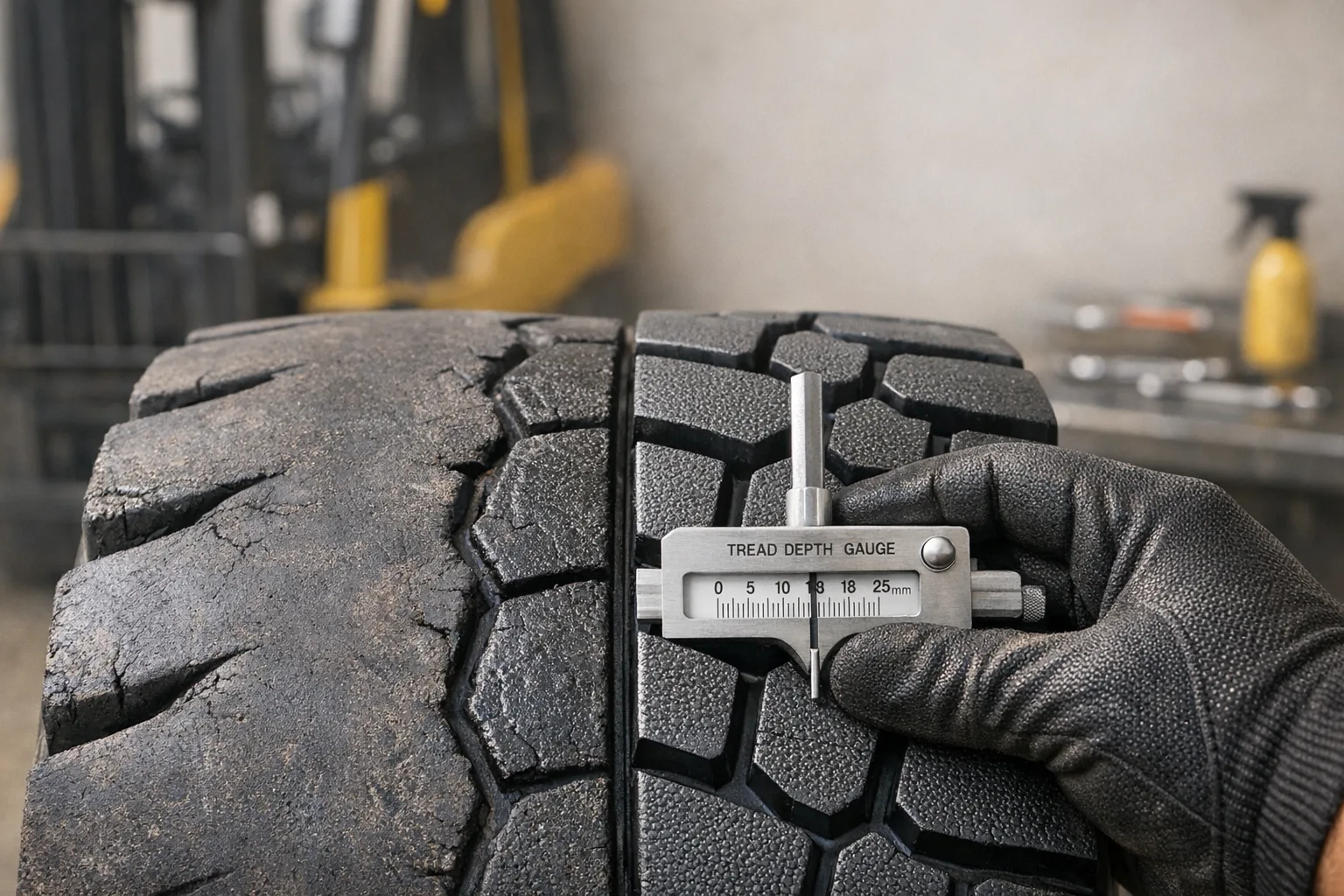
Don’t rely solely on your eyes. Use tools like a pressure gauge for pneumatic tyres and a tread depth gauge to measure remaining rubber accurately. If a tyre shows defects, leaks, or other safety concerns, OSHA requires the forklift to be taken out of service until fixed by certified personnel. Document your findings in a log to monitor wear patterns and plan retreading or replacements in advance.
Proper Inflation and Load Management
Once inspections are complete, focus on keeping the tyres properly inflated and managing loads responsibly. For pneumatic tyres, maintaining the right air pressure is critical. Proper inflation ensures smoother handling, reduces the risk of blowouts, and improves fuel efficiency. Underinflated tyres wear out faster and reduce traction, while overinflated ones can cause uneven wear and compromise stability. Use a reliable gauge to check pressure daily, and avoid bleeding air from hot tyres to prevent overheating.
"Consistently maintaining the correct air pressure of your tyres for the speeds being driven and the weights being put on them is the single most important maintenance factor in casing longevity." - AcuTread
Load discipline is equally important. Never exceed the forklift’s rated capacity, and always centre the load before moving. Off-centre loads or sharp manoeuvres like fast cornering can shift weight unevenly, leading to tyre damage such as chunking, base separation, and radial cracking. These issues arise from excessive internal heat buildup. Operators should also avoid sudden braking, speeding, and tight turns, which can cause flat spots and accelerate wear. When parking, lower and remove loads to prevent flat spots on solid or cushion tyres. Together, these practices help maximise tyre performance and lifespan.
Scheduling Retreading at the Right Time
Daily maintenance plays a vital role in determining the right time for retreading. Timing is crucial - schedule retreading before tread depth falls below 4/32" for steer tyres or 2/32" for drive and trailer tyres to avoid casing damage that could make retreading impossible. For cushion tyres, consider retreading when wear reaches the top of the size numbers or letters on the sidewall. A simple guide is the "two-inch rule": if the tyre has lost two inches or more from its original height, it’s time to act.
Daily inspections also help catch issues like embedded debris, cuts, or uneven wear patterns early, preserving the tyre’s casing. Allow tyres to cool for at least 7–8 hours before inspecting them to get an accurate assessment.
"Whenever possible let the forklift tyres cool down for the duration of one whole shift - meaning seven or eight hours at least." - Continental
For a quick tread check, try the "penny test": insert a penny into the tread groove. If the top of Lincoln’s head is visible, the tread is too shallow, and the tyre needs immediate attention. Regular cleaning is also important - wash tyres to remove salt, chemicals, and debris like nails or glass that can cause premature wear and casing damage.
Conclusion
Retreading forklift tyres is a smart way to cut costs, improve safety, and minimise environmental impact. The financial benefit is clear: retreading can save between 30% and 50% compared to buying brand-new tyres.
"A premium tire/retread combination can last up to 500% longer than ultra-low-cost new tires used only once." - Bridgestone Team, Bandag
But it’s not just about saving money. Retreaded tyres also meet the same safety standards as new tyres, ensuring they provide the traction and grip needed for heavy-duty operations. Their proven reliability makes them a trusted option in tough industrial settings. On the environmental side, retreading uses only 7 gallons of oil per tyre, compared to the 22 gallons needed for manufacturing a new one, significantly reducing oil consumption and waste.
To get the most out of retreaded tyres, regular maintenance is key. Keep tyres properly inflated, inspect them daily, and plan to retread when the tread depth reaches 6/32nds to maintain the casing’s integrity.
FAQs
How do I know if my forklift tires need retreading?
To figure out if your forklift tires are ready for retreading, start by checking the tread depth. If it’s worn down to around 4.8 mm (3/16 inch), it’s a good indicator that retreading might be necessary. Also, examine the tires for visible damage like cracks, missing chunks, flat spots, or uneven wear. These issues can compromise both safety and performance.
Pay attention to signs such as reduced traction or handling difficulties, as they might signal that the tires are no longer safe to use. Regularly inspecting your tires and sticking to the manufacturer’s recommendations can help spot these issues early. If the tires remain structurally sound, retreading offers a smart way to extend their life while also being lighter on the budget and better for the environment.
What are the key environmental benefits of retreading forklift tires?
Retreading forklift tyres offers a practical way to reuse existing tyre casings, cutting down the need for manufacturing brand-new tyres. This not only saves raw materials, like rubber and steel, but also reduces the energy typically consumed in producing new tyres.
By giving tyres a longer life, retreading helps to limit the number of discarded tyres that end up in landfills, contributing to improved waste management. It also lessens the environmental strain caused by extracting resources and manufacturing processes, making it an eco-conscious option for businesses looking to shrink their carbon footprint.
In essence, retreading supports recycling efforts, reduces waste, and preserves natural resources, fitting perfectly with environmentally friendly practices and sustainable goals in industrial settings.
How does retreading improve the safety and performance of forklift tires?
Retreading enhances the safety and efficiency of forklift tyres by restoring their strength and functionality through a detailed process. The journey begins with a thorough inspection of each tyre to identify any damage or wear that might compromise safety. Once assessed, the worn tread is carefully removed, and the tyre is prepared with precision to ensure it meets alignment and balance requirements.
Next, fresh rubber is applied using methods like Mold Cure or Pre Cure. These techniques create a strong bond and ensure proper vulcanisation, effectively renewing the tyre’s grip, durability, and resistance to issues like tread separation or blowouts. By extending the tyre’s lifespan without compromising safety or performance, retreading proves to be a smart, budget-friendly, and environmentally conscious choice for forklift operations in challenging conditions.
Looking for Forklifts or Parts?
Fazlerasheed & Co. supplies reconditioned forklifts, genuine spare parts, and traction batteries across Pakistan. Get a free quote today.